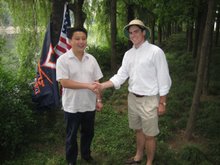
Sunday, July 1, 2007

Predestination in China?

Today, the official birthday of the CCP, a group of us metroed downtown to visit the site of the founding of the Communist Party in one of Shanghai's preserved Shikumen ("stone entranceway") houses. The first communists were clever to meet in that particular place in 1921, as now it is the site of Shanghai's most fashionable development project (called XinTianDi) that houses all of Western capitalism's finest shops, restaurants, and bars. We were disappointed to find the museum all but empty of homage-paying citizens, and we were in fact the only people looking at the exhibits.

The exhibits started with the above plaque, tracing the struggles of the working class to overcome foreign imperialism and bourgeois influence and to triumphantly achieve socialist egalitarian utopia. Unfortunately most of the exhibit plaques and photo captions lacked English translations so I was left to assume that they contain a rather slanted portrayal of the century's events.

Friday, June 29, 2007

Forbidden Flag

For some reason I love flags. Here is pictured the UVA flag in Beijing's Forbidden City. By this time the plainclothes policemen had lost interest and I felt safe in proudly swinging this fine emblem of Western pride.

Today we were lectured by a retired UVA professor named John Israel who spoke about China in general, with specific references to disparities between countryside and city. He gave us a slideshow that paired images of this disparity, for example Shanghai advertisements with oxen-powered ploughs in small villages. Apparently Roy Rogers said about the American Depression that it was the first time people drove to the poor house in cars. This is not the case in China, and it will apparently be a long time before these disparities even out.

In addition to the well-known issues of pollution, corruption and education, he told us that China faces a potentially massive AIDS situation as well. Despite the Premier's offer to provide all Chinese with anti-retroviral medications, the Chinese peasants still face bleak medical futures because of the inefficient distribution system and the inconvenience of obtaining these medications. For example, a peasant has to get a full-body checkup before receiving the medication, and the checkup apparently can cost half a year of wages. Furthermore, only 2 months of medication are distributed at a time. A couple of weeks ago we learned that something like 60% of Chinese still live in the countryside. This figure is worrying to the government because the countryside has traditionally been the breeding ground for discontent and the source of revolutionary power.

Thursday, June 28, 2007

Pale Skin in China

While in Beijing, Sarah and the other Jefferson Scholars arrived in Shanghai, leaving us with a one day overlap before they returned to the USA on Monday. They concluded their three week tour of Japan, China, and Tibet by absorbing some of Shanghai's air pollution. Sarah's light skin and height attracted considerable praise wherever we went.

We are pictured at the campus' Mao statue, also the site of the bi-weekly "English Corner", where students practice English. Some students also like to roller-blade beside the statue. Interesting. We are going to observe the Communist Party celebrate its birthday on Sunday morning so there will be more to say with respect to Party matters later this weekend.

Today I had dinner with two Chinese friends whose motives for befriending me have yet to become clear. I have become slightly disillusioned by the phenomenon of fast-friendship, as it seems that most Chinese see dollar signs when they see Americans. Even friendship for the sake of friendship can easily be the desire to practice English in disguise. In China, speaking English means making money, and so one can easily attract a following if one is ready to offer English instruction. An American ex-patriot has told me that it takes a very long time to actually befriend native Chinese, and so I remain skeptical that most of my acquaintances here are looking for personal gain. Yet, at the same time I have to admit that I'm also looking out for my own financial future by coming to China in the first place. Nevertheless, it is harder as a foreigner to judge sincerity in this culture.

Wednesday, June 27, 2007

Good Fences Make Good Neighbors

After driving about 45 minutes outside of downtown Beijing to see a section of the Great Wall, I was rather disappointed to overhear a middle-aged American lady ask her friend, "Which side is Mongolia?"

At long last, Moosedung resumes. We spent last week in Beijing seeing all of Beijing's famous sites in the style of "If it's Tuesday, this must be Belgium". Beijing is a very large city with lots of tourists, particularly Chinese domestic tourists come to see their esteemed capital. After taking the overnight train from Shanghai, we were led straight to Tiananmen Square by our tourguide. With the UVA flag waving majestically from a bamboo pole, we began parading across the large space brushing aside peddlers left, right and center. Suddenly a police van full of plainsclothes operatives zoomed across the square. It's driver said something quickly, pointed to the flag, and I reluctantly furled it. Plainsclothes police then tailed our group rather conspicuously for the duration of our tour of the Forbidden Palace, and finally became convinced of our peaceful intentions.

We saw lots of things very quickly in Beijing. Unfortunately, Mao's mausoleum has been closed for renovation and we were prevented from seeing his preserved body floating in formaldehyde. Perhaps these special treats are to be unveiled just before the Olympics. As China's capital city under five dynasties, Beijing has a much better selection of traditional sites than Shanghai. Beijing also has a well-deserved reputation for its famous Peking Duck. Well worth trying.

We enjoyed a morning in one of Beijing's more famous parks and observed the typical morning activities of Beijing's older generation. As one strolls around such parks in the early morning, one can find people excercising birds (by swinging their cages), practicing Taiji, ballroom dancing, playing Mahjong, practicing instruments, singing opera, and doing some sort of weird exercise that entails smacking one fist into the palm of the other hand while walking.

I was glad to get back to Shanghai, perhaps because it is most familiar, but not less because there are fewer tour groups. The weather has finally become sticky and oppressive. We have air-conditioned classrooms and bedrooms, but this is certainly not the time to go out and experience life in the rice paddies.

Saturday, June 16, 2007

Old Chinese Men

Throughout Shanghai, a careful people-watcher will notice that older men love to strike poses on the side of the street. This phenomenon is particularly visible on a Saturday morning between 8am and 9am as all of Shanghai's retired men escape the confinement of their apartments and stride down the street until they find a good perch, whereupon the goal seems to be to stand as quietly and majestically as possible for about thirty minutes.

After people-watching, I joined a group of students headed towards an enormous fabric market. The girls got fitted for traditional qi pao's (the long silk dresses) and then we went for a surprisingly enjoyable lunch. After a long nap, my roommate Ryan, myself, and several friends soaked in a bit of Shanghai's jazz scene. The evening culminated with the arrival of Sugar Mama, a back up singer for Tina Turner back in the day. Sugar Mama's not insignificant figure and her powerful voice aroused significant admiration amongst our Chinese companions.

Friday, June 15, 2007

West Meets West

The Western Hemisphere met the Western Hemisphere today in the Ritz Carlton's famous Western Grocery Store. Edward Bennett and I needed cheese, port, and coffee. After dropping by the cloth market and continuing our spending spree on tailor-made clothes, we headed for the safe haven that tantalized us with rumors of milk products and aperitifs.

Along the way we learned that many visitors to Shanghai never actually leave the confines of this sprawling hotel complex. Indeed, the Ritz has its own Starbucks, its own pharmacy, Shanghai's only Western grocery store, and God alone knows what else. In every direction, long formations of Americans paraded from their buses to the safety of quality-controlled bars with air-conditioning. And every one of these good old boys sported a large Starbucks drink as their exposed chubby legs reflected the shimmering night lights of the bustling mothership that is this hotel.

With a small picnic in hand, we taxiied to the Bund (Shanghai's old financial district by the water), enjoyed our first course, and I saw Shanghai's nighttime skyline for the first time. A group of four Chinese college students admired our picturesque spread on one of the stone benches and probably thought that we would be an easy target for tea-racketeering. Fortunately, I surprised them with language skills and they realized, of course, that we were in fact old China hands. They had seen Gone with the Wind so I took the opportunity to explain to them how America's plantation life continues to thrive, and that slavse labor was paying for our trip to China.

We then strolled along the large Huangpu River through the crowd of beggars and lovers to our destination, "M on the Bund", recommended by the Venerable Doc. Shurmer. Seated on the terrace, we both reflected that the evening had so far been our most enjoyable in Shanghai. And then we realized that our evening had approximately nothing to do with the Orient. We drank Australian wine, ate Australian lamb, dined in a European colonial building, looked out upon a European trading city built in the style of the West, our delicious bread and cheese had come directly from Europe to the Ritz, and we were both, of course, Americans. I know what you're thinking and I took the liberty of asking - no, they didn't have a single pair of chopsticks in the establishment.

Our waiter, however, provided the tipping point- a Scotsman! On a whim, I asked him his family name. Yes, he was of the clan Fraser from Inverness. Yes, he was a distant cousin of myself and even Edward (whose Grandmother was a Fraser)! Yes, his brother is the current Clan Chief of my people! Yes, this fellow lives in our ancestral home. Yes, he and his brother have just launched the Fraser Clan's new line of Scotch Whisky - "The Old Fox" - in memory of our common ancestor Simon Fraser (the last to be executed at the Tower of London). Shanghai, of all places.

There is much to be said for the colonial approach to Shanghai. Let alone the fact that our dinner cost approximately sixty times the amount that a meal on the street would cost (don't worry Mom - dinner was still reasonable). Order tailored clothes in the morning, dine on lamb in the evening, and speak a little Chinese to the cab driver on the way back to the dormitory.

Thursday, June 14, 2007

American Culture for All Chinese!

As I found out today, technologically capable Chinese have full access to American culture. With the help of a website called baidu.com and the lack of copyright enforcement, I have learned how to instantly access everything. Yes, everything. Every American movie, TV show, song, MP3, etc. Over here, a single website can instantly give you access to movies as yet unreleased in the U.S.A.

This phenomenon confused me a bit. On the one hand my computer gets blocked if I search "Falungong Practioner", and on the other I can have access to every vice or virtue of American society within five seconds. Edward's roommate, officially known as Leo Claudius Nimbus (see Edward's Blog - sericus.blogspot.com - for the full story) introduced me to these wonders on his laptop with gleeful joy. He asked me if I knew what "Bit Torrent" meant. Edward and I began explaining about the etymology bits of data and torrents of rain, but he interrupted us excitedly saying: "No, no, no, it means --- unlimited access to American culture!!!" Apparently he back to his parents' home every weekend, as does every normal Chinese college student, and watches American movies on his laptop. And yet the government only officially allows twenty American movies to be introduced to China every year.

Yesterday Leo Claudius Nimbus explained why we have always received free watermelon after every meal. Apparently the unsaid arrangment is that the restaurant gives you fruit instead of giving you a receipt. This way, the restaurant avoids paying taxes and customers get fruit.

I'll share another interesting Chinese oddity. On the bus ride to Hangzhou last weekend we asked our tourguide why every farmhouse had one of two types of towers rising above the second floor. Well, it's rather obvious. If the family's child (remember, China's one child policy) is male, the tower gets to be pointed. If the family's child is female, the tower's roof is flat. Just like the earth.